5 Ways to Settle into a New Bedroom
The boxes go first. Most people clear them inside 30 days, and then the room just sits there, half furnished, waiting on a decision nobody feels ready to make.
South Louisiana makes a few of those decisions for you. Summers here run above 70 percent relative humidity, and that shapes what goes on the bed long before it shapes what goes on the walls.
So start with what you already do. When you wake, where the bag lands, which side of the bed you actually climb out of.
That sounds too small to matter, and it is the part most people skip. A room arranged around a routine somebody already has feels settled within a fortnight. One arranged around a mood board stays faintly wrong for a year.
1. Plan the Room Around the Bed and Its Walking Routes
The bed comes first. Every other piece takes its cue from it, including where a dresser fits and whether there's room for a reading chair at all.
Leave 2 feet clear on the walking side. Anything tighter and it's a sideways shuffle between door and closet every morning, the kind of thing that never shows up on a floor plan and is perfectly obvious by week two.
A queen measures 60 inches by 80 inches. Set one down carelessly and it blocks a closet door outright. So walk the route before you commit. Carry a laundry basket through the gap, because that's the real test, not a tape measure.
And don't forget the closet itself. A bi-fold door typically needs about 24 inches of swing, which has to stay clear.
On a tight footprint the door swing and the walking route end up sharing the same strip of floor. Work out which one gives.
2. Choose Breathable Bedding and a Few Cooling Habits
Anyone arriving from a drier state tends to make the same mistake, which is treating this as a heat problem. It's a moisture problem, and the two behave nothing alike.
A mattress in a room sitting at 70 percent humidity gives up long before anybody complains about the temperature, and bedding that worked beautifully in Denver will simply stay damp here. A dehumidifier earns its keep for a good 3 months of the year.
The figure worth aiming at indoors is below 60 percent, which is where the EPA's guide to moisture and mold control draws its line. A cheap hygrometer makes that easy to watch, and your first reading will probably surprise you.
Fiber content tells you more than anything else printed on the packet. Cotton, linen and percale all breathe; tight polyester blends don't, however luxurious the photography looks.
Comfort guidance tends to land between 65 and 68 degrees Fahrenheit, and the Sleep Foundation's temperature guidance explains the reasoning. Getting there without running the air conditioner flat out is the trick.
Weighted bedding is where opinion splits. Some people sleep better under it. Others find it stifling by August, so it helps to be clear about what the thing actually is.
Baloo Living's cooling weighted quilted blanket is one example of the category. It's cotton throughout, lining included, with lead-free glass beads in sewn pockets. The word cooling describes that construction and does not mean any cooling technology.
Sizes run throw, Full/Queen and King, from 12 lb to 25 lb. Baloo assigns weight by sleeping position and by whether the bed is shared, where much of the category uses a share of body weight. Neither method suits everyone.
Two caveats before anybody buys. The word cooling describes the all-cotton build rather than any cooling technology; and the King is too big for a domestic washer, so laundry day means a commercial machine.
None of this treats anxiety, insomnia or anything else. It's a comfort layer. Pick it the way somebody picks a heavier duvet.
3. Keep the Palette Restrained and the Accents Personal
One dominant neutral, one supporting tone, one accent color. Then stop. Really, stop there.
Designers call it the 60-30-10 split. Roughly 60 percent of the room goes to the neutral, 30 percent to the supporting tone, and the last 10 percent does the accent work. Add a fourth color and the whole thing starts arguing.
Accents earn their place by carrying a story. Filling a shelf isn't the same thing, and a dozen small purchases that all say new will settle a room more slowly than a few framed prints and one textured throw.
Buy the big restrained pieces first. Let the accents turn up as you find them.
4. Layer Ambient, Task, and Natural Light
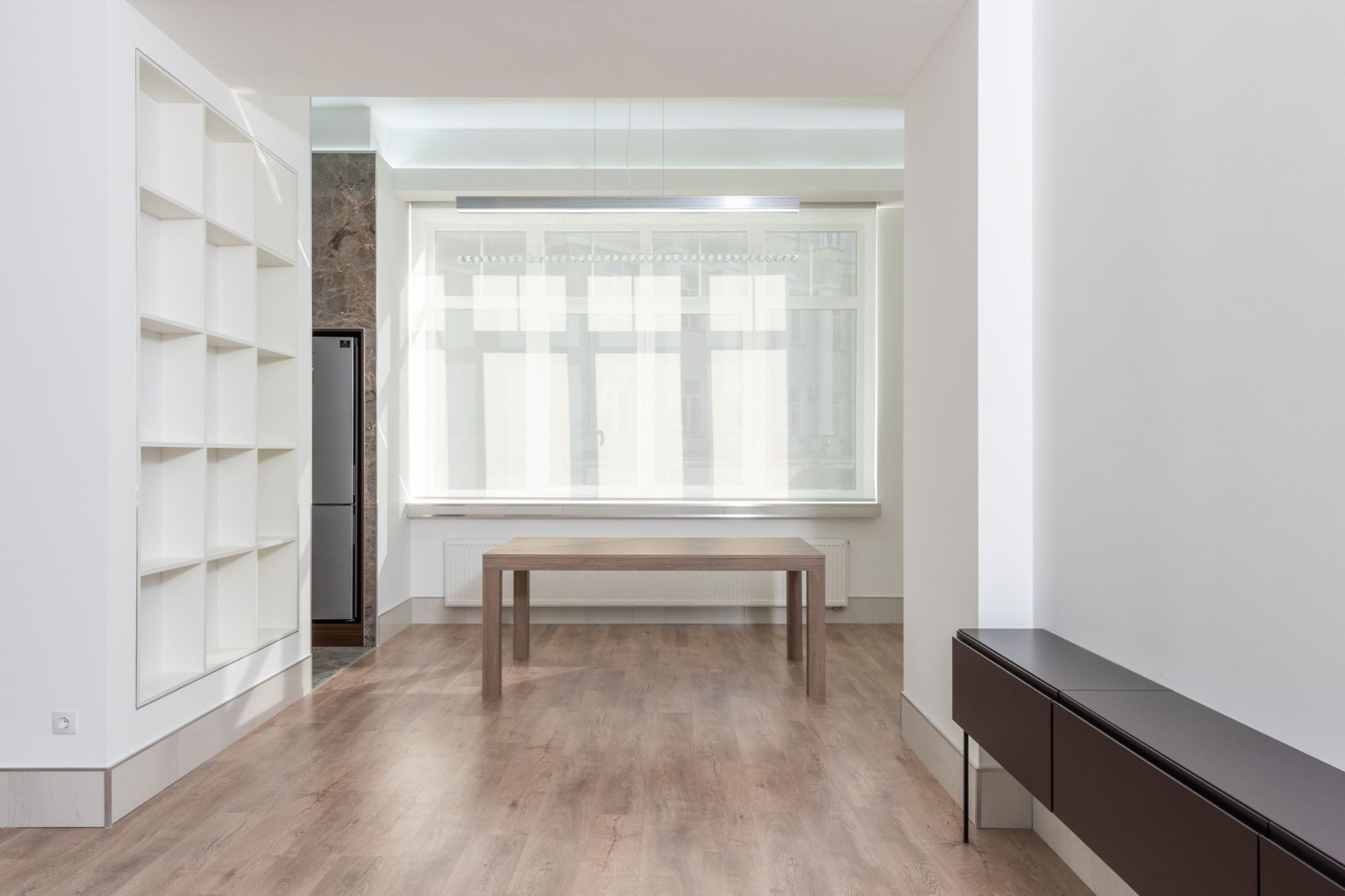
Light isn't one thing. A bedroom needs at least three: ambient light for the whole room, task light for reading or dressing, and whatever comes through the window.
For reading in bed, most people settle around the old 60 watt brightness, which an LED now delivers on roughly 9 watts. Push much past that and the room stops feeling like a bedroom.
A dimmer on the overhead fixture covers the ambient job. One lamp beside the bed covers the task job, on whichever side actually gets read on.
Natural light is the one thing nobody can retrofit. So the window drives the decision and the fixture follows behind it.
On the side of the house that catches morning sun, blackout liners rated 100 percent light-blocking are worth the money. Somewhere that only sees afternoon light, a sheer layer on its own will do, and doubling up only makes the room gloomy.
5. Close Off Clutter With Storage and a Landing Place
Closed storage wins here, every time. A lid or a door hides the pile nobody has sorted yet, which open shelving in a room still holding boxes simply can't do.
Matching bins under the bed or inside the closet clear the floor without forcing the unpacking to finish on any deadline. Bins buy time, and time is the thing nobody has in the first month.
Then there's the landing place. One tray, roughly 8 inches by 10 inches, takes keys, a bag and a charger, and those things stop drifting onto the nightstand and the dresser both. One tray beats a whole weekend of sorting.
Storage first, character second. Art chosen firsthand, books still being read, a plant suited to the room's own light. Then wait about 30 days before buying anything more.
Your Next Steps
The temptation is to attempt all five over one Saturday, which is how rooms end up half done in five separate ways. Finish one this week instead, and make it the bed.
Get the 2 feet of walking clearance right and everything after it is easier to judge. A settled floor plan is what makes a new bedroom feel finished. The rest is decoration.
A local Reve agent can check room dimensions against a buyer's own stated needs before a layout gets chosen (a secondary bedroom often runs 10 feet by 12 feet). For a home already owned, these five changes work just as well, room by room.
Categories
Recent Posts